
Pacific Time
Pacific Standard Time - PST (UTC-8)
Pacific Daylight Time - PDT (UTC-7)
Vancouver
Las Vegas
Los Angeles
Mountain Time
Mountain Standard Time - MST (UTC-7)
Mountain Daylight Time - MDT (UTC-6)
Edmonton
Denver
Phoenix
Central Time
Central Standard Time - CST (UTC-6)
Central Daylight Time - CDT (UTC-5)
Winnipeg
Chicago
Eastern Time
Eastern Standard Time - EST (UTC-5)
Eastern Daylight Time - EDT (UTC-4)
Toronto
New York
Mountain Standard and Daylight Time
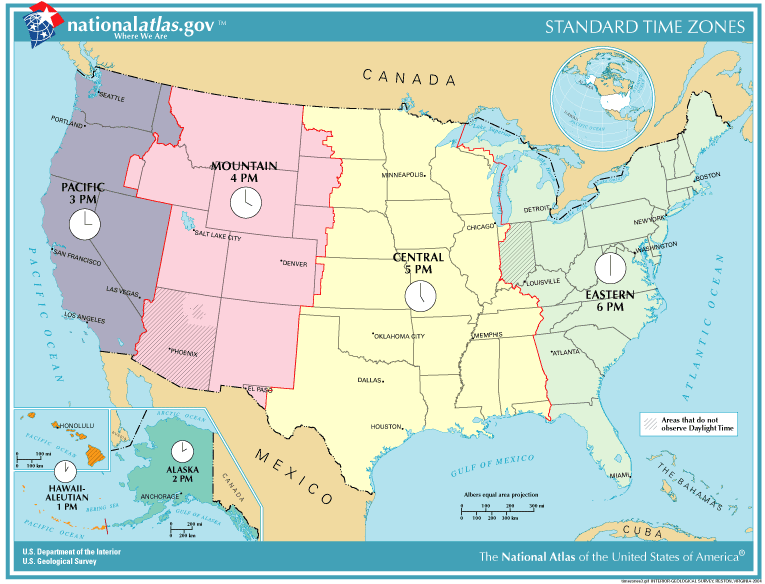
Mountain Time observes standard time at seven hours behind UTC (UTC-7), shifting to six hours behind (UTC-6) during daylight saving time. Standard time in the zone is based on the mean solar time of the 105th meridian west of Greenwich.
Mountain Time (MT)
In the United States and Canada, the zone is generically called Mountain Time (MT) — specifically Mountain Standard Time (MST) during winter, and Mountain Daylight Time (MDT) during daylight saving time. The name comes from the Rocky Mountains, which run from northwestern Canada down to New Mexico and lie almost entirely within this time zone. Since 2007, the shift from MST to MDT takes place at 2:00 a.m. on the second Sunday of March, and the shift back to MST takes place at 2:00 a.m. on the first Sunday of November.
Arizona
Most of Arizona does not observe daylight saving time, so for much of the year it keeps the same clock time as Pacific Daylight Time next door, even though it's still Mountain Standard Time by name. The Navajo Nation, which spans much of northeastern Arizona, does observe daylight saving time — while the Hopi Nation, an enclave entirely within Navajo land, does not.
Daylight Saving Time in the USA and Canada
Daylight saving time begins at 2:00 a.m. on the second Sunday of March and ends at 2:00 a.m. on the first Sunday of November, in every USA and Canada time zone that observes it.
North America DST Change Dates
| Year | Begins | Ends |
|---|---|---|
| 2021 | Sunday, 14 March, 02:00 | Sunday, 7 November, 02:00 |
| 2022 | Sunday, 13 March, 02:00 | Sunday, 6 November, 02:00 |
| 2023 | Sunday, 12 March, 02:00 | Sunday, 5 November, 02:00 |
| 2024 | Sunday, 10 March, 02:00 | Sunday, 3 November, 02:00 |
| 2025 | Sunday, 9 March, 02:00 | Sunday, 2 November, 02:00 |
| 2026 | Sunday, 8 March, 02:00 | Sunday, 1 November, 02:00 |
| 2027 | Sunday, 14 March, 02:00 | Sunday, 7 November, 02:00 |
| 2028 | Sunday, 12 March, 02:00 | Sunday, 5 November, 02:00 |
| 2029 | Sunday, 11 March, 02:00 | Sunday, 4 November, 02:00 |
| 2030 | Sunday, 10 March, 02:00 | Sunday, 3 November, 02:00 |
| 2031 | Sunday, 9 March, 02:00 | Sunday, 2 November, 02:00 |
Daylight saving time begin and end dates in the USA and Canada.
North American Time Zones
The same eight time zones from the comparison above, organized by UTC offset instead of by name — useful for seeing which zones share a clock time once daylight saving time shifts them.
Time Zones by UTC Offset
| UTC Offset | Standard Time | Daylight Time |
|---|---|---|
| UTC-10 | Hawaii-Aleutian | — |
| UTC-9 | Alaska | Hawaii-Aleutian |
| UTC-8 | Pacific | Alaska |
| UTC-7 | Mountain | Pacific |
| UTC-6 | Central | Mountain |
| UTC-5 | Eastern | Central |
| UTC-4 | Atlantic | Eastern |
| UTC-3:30 | Newfoundland | — |
| UTC-3 | — | Atlantic |
| UTC-2:30 | — | Newfoundland |
Time zones in North America, by UTC offset.
GMT and UTC
Greenwich Mean Time (GMT) originally referred to mean solar time at the Royal Observatory in Greenwich, London. Coordinated Universal Time (UTC) is the modern, atomic-clock-based standard that has replaced it for precise timekeeping — but the two are close enough that they're used interchangeably in everyday contexts, including throughout this page.